

How VR Creates Meaningful Conversations in Care Settings
Virtual reality (VR) is often thought of as an individual experience. One person puts on a headset, enters a virtual environment, and explores it independently. But in a care setting, the value of VR does not necessarily stop when the headset goes on.
When VR is introduced thoughtfully, an experience that appears to be individual can become a shared activity. It can give residents, care workers, families and other residents something tangible to talk about, creating opportunities for conversation, reminiscence and social interaction.
Turning an individual experience into a shared activity
One challenge care settings face is finding activities that encourage genuine interaction rather than simply keeping people occupied. An activity might be enjoyable, but that does not necessarily mean it creates opportunities for people to connect.
Although only one person may be wearing the headset at a time, the people around them can still be involved. A staff member can sit alongside the resident and ask what they can see. Another resident might recognise the location. A family member might remember visiting somewhere similar with their loved one.
The experience becomes something everyone can participate in, even if they are not wearing the headset themselves. A virtual environment also gives people something specific to respond to. Rather than asking an open question such as "What did you used to do for fun?", a member of staff can ask about what the resident is seeing in front of them.
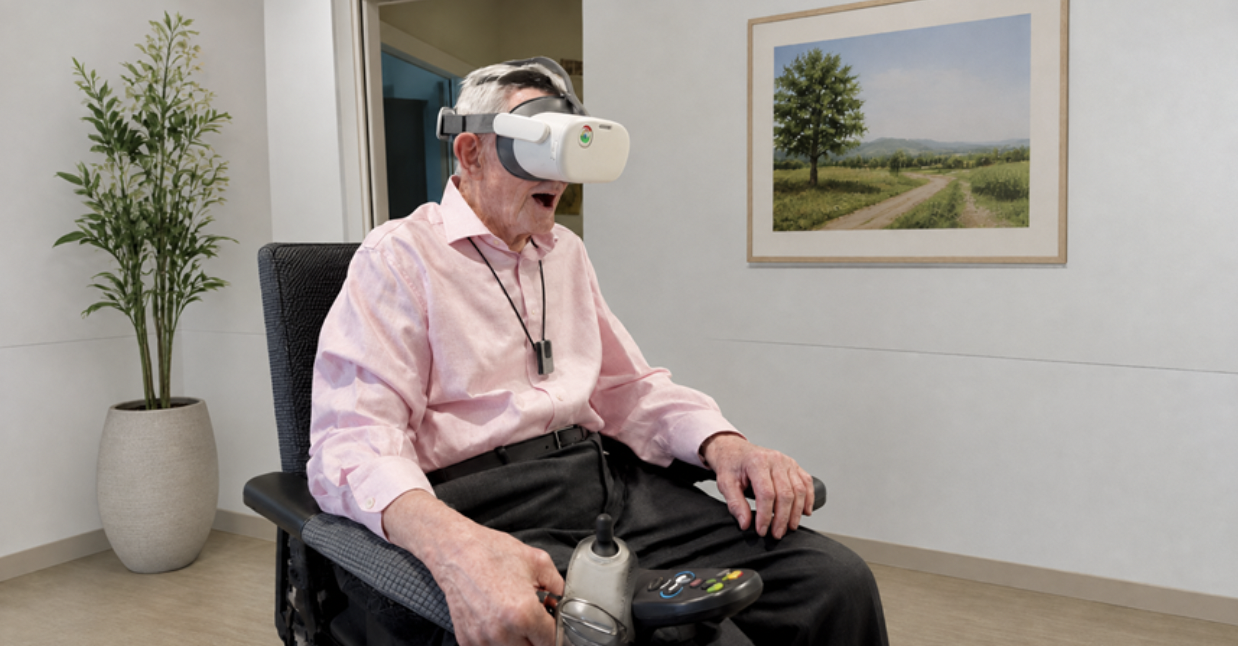
What do you think of this place?
Does it look familiar?
Have you ever been somewhere like this?
Who would you have visited with?
These conversations can develop naturally from what the person is experiencing.
VR and reminiscence
Reminiscence is already an important part of many activities for people living with dementia. Photographs, music, familiar objects and stories from the past can all be used to encourage people to recall experiences and share memories.
VR provides another way of approaching reminiscence by allowing someone to explore an environment rather than simply looking at a static image.
Imagine a resident being able to explore a familiar seaside location. They might recognise the promenade, the buildings or the landscape. Perhaps it reminds them of holidays with their family, a particular period of their life or somewhere they visited regularly.
The important part is not necessarily whether they can remember every detail. The experience can simply provide a prompt for conversation.
One memory can lead to another. A familiar building can prompt a story about a job. A particular landscape can lead to a conversation about family. Seeing an environment that resembles somewhere from someone's past might encourage them to talk about experiences that would not otherwise have come up.
For people living with dementia, having something concrete in front of them can sometimes make it easier to engage with an activity than being asked to retrieve a memory without any prompt.
Giving people something to talk about
Conversation in care settings does not always happen naturally. Residents may have different interests, backgrounds, and communication abilities. Someone may not feel comfortable joining a group conversation, or may struggle to know what to say when presented with a broad question.
If someone is exploring an environment, everyone in the room can talk about what they are seeing. Staff can ask questions, family members can share their own experiences, and other residents can contribute their memories.
That means the conversation is not solely dependent on the resident remembering something independently. The environment itself becomes part of the conversation.
This can be particularly useful when working with people who find verbal communication challenging. They may be able to point towards something they recognise, describe what they can see, or respond to simple questions about the environment.
The activity can therefore be adapted around the individual rather than expecting everyone to participate in exactly the same way.
The role of staff
For care teams, the headset should not be viewed simply as a piece of technology that is handed to a resident. How the experience is introduced can make a significant difference.
A member of staff can sit with the resident, observe their reactions and use the experience as a starting point for interaction. They can ask questions, encourage the resident to describe what they are seeing, and give them time to respond.
It also creates opportunities for staff to learn more about the people they support. A resident might mention a place they used to visit, describe a job they had, talk about a family member or share an interest that staff were previously unaware of. These conversations can help staff understand residents as individuals, rather than focusing solely on their care needs.
That can be particularly valuable when supporting people living with dementia, where understanding someone's history, preferences and interests can help care become more personalised.
Families can be part of the VR experience too
Visits to care homes can sometimes become repetitive. Families may understandably want to talk to their loved one but struggle to find new topics of conversation. A VR experience can provide a shared activity to build a conversation around.
A family member might recognise a location the resident is exploring. They might have visited somewhere similar together or be able to ask questions about what the resident remembers.
Even when the resident does not remember a particular place, the experience can still provide an opportunity to talk, react and spend time together. The technology therefore becomes less important than what it enables people to do together.
VR does not have to be a solitary activity
There is a tendency to think about virtual reality as something that separates people from the world around them. In care settings, that does not have to be the case. With the right approach, VR can actually encourage interaction. The headset might be on one person's head, but the experience can involve an entire room.
Residents can watch, listen, and contribute. Staff can use the experience to start conversations. Families can share memories. Other residents can join in with their own stories. That changes the role VR can play within a care setting.
It is not simply about giving someone somewhere else to go for a few minutes. It can be about creating an opportunity to communicate, reminisce, discover something about a person, and spend time together.
Creating more meaningful activities in care
Rather than becoming another activity residents complete independently, VR can be used as a tool for bringing people together and creating opportunities for meaningful conversation.
For care providers looking at new ways to support engagement, reminiscence and social interaction, VR is worth considering as more than an entertainment tool.
If you would like to find out how Recreo VR is helping care organisations use immersive experiences to encourage engagement, reminiscence and social interaction, get in touch with the team.